LAND CONVERSION & INDUSTRIAL USE

Industrial N.A.

Converting agricultural land for industrial use is not just a change in the land record. It requires the proposed industrial use to fit the applicable planning, revenue, access, infrastructure and environmental framework. TANVI Consultancy helps organise the case from the first land-record review through application coordination and post-approval follow-up.

Land-record review Industrial-use assessment Application support Authority coordination
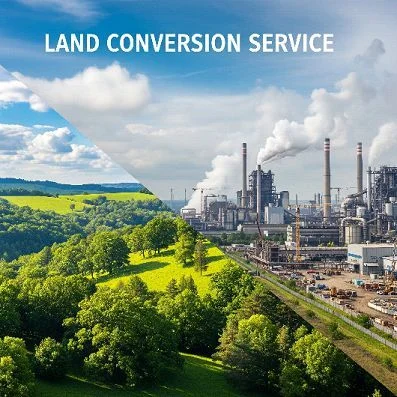
Agricultural land transitioning toward industrial land use
WHAT INDUSTRIAL N.A. MEANS

A land-use approval aligned with the proposed industrial activity.

Agricultural land cannot automatically be used for a factory, workshop, processing unit, warehouse or other industrial purpose. The land-use position has to be checked against the Maharashtra Land Revenue Code, the applicable Development Plan or Regional Plan, and any project-specific approvals.

For an industrial proposal, the review normally goes beyond ownership records. Road access, zoning, acquisition status, water availability, drainage and sewage arrangements, pollution-control requirements and conditions attached to the land can all affect whether the proposal can move forward.

Important: The exact route can differ by location and planning status. In some notified/planned areas, later amendments to the Maharashtra Land Revenue Code provide a different mechanism from the traditional standalone N.A. permission process. The applicable route should therefore be confirmed for the specific survey number before filing.
Illustration of agricultural land conversion to non-agricultural use
LEGAL & PLANNING CHECK

Start with feasibility before spending on the application.

A strong Industrial N.A. case begins by checking whether the land and the proposed activity are compatible before preparing a large document set.

Revenue record

Review 7/12, 8-A, mutation entries, tenure conditions, other-rights entries, revenue dues and ownership continuity.

Zoning & planning

Confirm whether the proposed industrial use is consistent with the applicable Development Plan, Regional Plan or planning authority rules.

Legal access

Check approach road, right-of-way documents, highway/PWD implications and whether the site has lawful access suitable for the proposal.

Utilities & disposal

Industrial proposals may need credible arrangements for water supply, sewage, storm water, effluent and other basic infrastructure.

Restricted areas

Forest, eco-sensitive, acquisition, reservation, coastal or other restricted conditions can change the approval path or require additional clearances.

Environmental interface

For industrial use, pollution-control requirements may need to be considered alongside the land conversion and development approvals.

INDUSTRIAL N.A. WORKFLOW

A practical path from agricultural record to industrial-use approval.

The exact authority and sequence can vary with the district, planning jurisdiction and nature of the land. TANVI Consultancy structures the work around the actual case rather than using a one-size-fits-all checklist.

LEGAL FOUNDATION

Maharashtra Land Revenue Code, 1966

Section 42 deals with use of agricultural land for non-agricultural purposes. Section 44 contains the traditional application framework for conversion/use-change cases. Later provisions and planning-area mechanisms may alter the route in specific locations.

Official Maharashtra text
01

Land-record due diligence

Collect and review ownership records, 7/12, 8-A, mutation history, tenure restrictions, tax/revenue status and other-rights entries.

02

Industrial-use feasibility

Match the intended industrial activity with zoning, site access, reservations, planning controls and project constraints.

03

Survey & technical drawings

Organise measurement plans, site/location plans, layout drawings, internal roads, open spaces and other drawings applicable to the proposal.

04

NOCs & supporting approvals

Identify the NOCs actually required for the parcel—for example local authority, road authority, acquisition, planning or environmental interfaces.

05

Application preparation

Prepare the prescribed proposal with the land details, proposed industrial use, supporting records and declarations required for the applicable route.

06

Submission & authority review

Coordinate filing, site verification, scrutiny and responses to queries or deficiencies raised during examination.

07

Charges & conditions

Applicable government assessment, conversion charges, premium or other statutory amounts are determined case-by-case by the competent authority.

08

Order & record update

After approval, coordinate the next record-related steps, mutation/remarks and compliance with conditions attached to the industrial-use permission.

DOCUMENT PREPARATION

Typical documents for an Industrial N.A. case.

Not every document below applies to every parcel. The final checklist should be created only after reviewing the survey number, tenure, zoning and proposed industrial activity.

Land & title records

  • Current 7/12 extract and Record of Rights
  • 8-A account extract
  • Relevant mutation / Ferfar entries
  • Title search and ownership documents
  • Revenue / tax payment receipts
  • Tenure or special-condition permissions, if applicable

Survey & layout records

  • Land map / Gut book plan
  • Certified measurement plan
  • Location and site plan
  • Industrial layout / plot utilisation plan
  • Internal road and open-space details
  • Architect appointment/registration documents where required

NOCs & clearances

  • Local body / planning authority NOC where applicable
  • Highway / PWD / access-related NOC where applicable
  • Land acquisition status confirmation
  • Boundary or right-of-way documentation where relevant
  • Pollution-control interface for industrial use, where applicable
  • Other project-specific permissions identified during scrutiny

Industrial infrastructure

  • Proposed water source / availability details
  • Sewage and drainage arrangements
  • Effluent handling concept, where relevant
  • Power and utility planning as applicable
  • Approach/access infrastructure
  • Supporting project details requested by the authority
WHY INDUSTRIAL CASES NEED EXTRA CARE

Industrial N.A. is connected to more than land classification.

An industrial site may ultimately need planning permission, building permission, factory-related approvals, MPCB consent, water permissions and utility infrastructure. A land conversion should therefore be approached with the intended project in mind—not as an isolated revenue-office exercise.

Zoning mismatchThe proposed industry may not be permissible in the applicable land-use zone.
Title / succession issuesIncomplete ownership continuity or disputed rights can delay or stop the proposal.
Access deficiencyIndustrial development needs legally defensible access and may face road-width or highway-control restrictions.
Special land conditionsNew tenure, tenancy, inam, reservation, acquisition or other restrictions may require separate action.
Environmental constraintsForest, eco-sensitive, CRZ or pollution-control requirements can introduce additional approvals.
Incomplete drawingsMismatch between survey records, measurements and proposed layout often creates avoidable queries.
TANVI Consultancy SUPPORT

One coordinated file instead of disconnected paperwork.

Our role is to help bring land records, drawings, required NOCs and the industrial-use proposal into one consistent case and coordinate the follow-up required for the applicable route.

Pre-application document review Land-use and zoning coordination Document checklist & proposal preparation Submission and query follow-up NOC / liaison coordination Post-order record follow-up
INDUSTRIAL N.A. FAQ

Questions worth answering before you file.

No. Industrial N.A. concerns lawful land use for the proposed industrial purpose. MPCB Consent addresses environmental permissions for the industrial activity. Depending on the project, both may be relevant, along with planning and building approvals.

No. Feasibility depends on zoning, title, tenure, access, reservations/restrictions, environmental constraints and the proposed industrial activity. The land should be screened before assuming conversion is possible.

There is no reliable one-number timeline for every case. Processing depends on the applicable legal route, completeness of documents, site/planning status, inspections, required NOCs and the time needed to resolve queries. We recommend assessing the specific parcel rather than relying on generic online estimates.

Statutory charges can vary with the land, location, use, assessment and the provisions applicable at the time of the case. TANVI Consultancy can help identify the expected heads of government payment after the land details are reviewed; a generic per-square-metre figure should not be treated as a final quotation.

Not necessarily. Industrial development can require separate planning/development permission, building approval, environmental permissions, factory-related approvals and utilities. The N.A. position is one part of the complete project approval chain.
PLANNING AN INDUSTRIAL LAND PROJECT?

Check the land before committing to the conversion path.

Share the survey number, location, current land record and proposed industrial use. We can start with a practical requirement review.

Contact TANVI Consultancy
WhatsApp